
← Back to the archiveSHORT / 082
Curves & geometryWatch the drawing↗
What If a 3D Surface Passes Through Itself?
BEHIND THE WORK
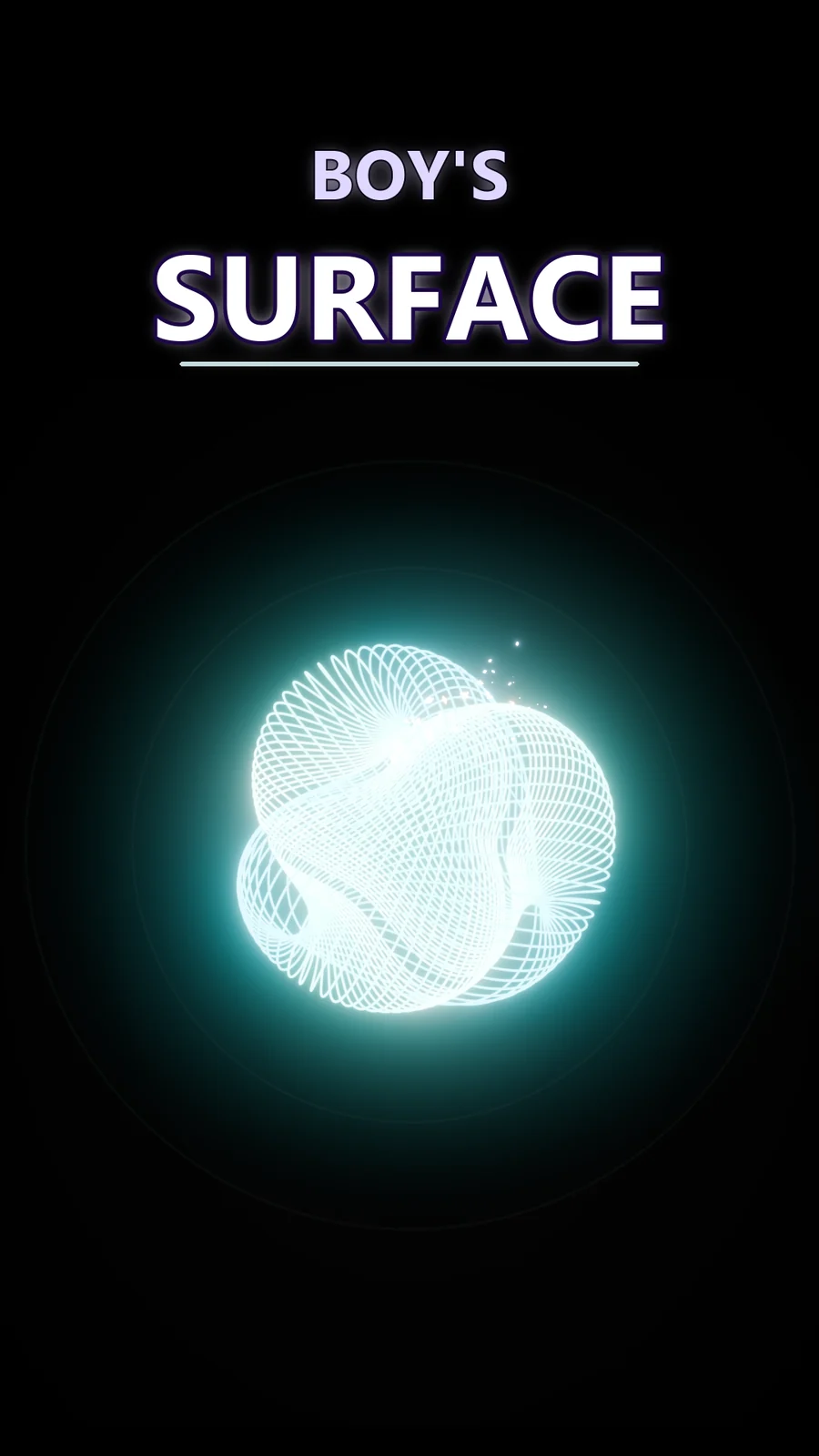
Can a surface have no edges, only one side, and pass through itself in 3D without creating a single sharp crease? In 1901, Werner Boy answered David Hilbert's challenge by proving that the real projective plane RP^2 can be smoothly immersed in 3D Euclidean space. Unlike the Klein bottle, Boy's surface features a single triple point where three sheets cross and a stunning 3-fold cyclic symmetry. Here, the Kusner-Apery rational parametrization is traced as an unbroken continuous helical manifold.
Related Video: Topology & The Impossible 3D Knots (https://youtu.be/0mvqG8cNyOw)
Artismathic turns equations into visual art - one function at a time.
#MathArt #Topology #DifferentialGeometry #Manifold #3DArt #Mathematics #Blender3D #BoysSurface #Shorts
THE MATHEMATICAL RULE
WATCH IT COME TO LIFE
Watch the drawing
YouTube loads only after you press play.