
← Back to the archiveSHORT / 076
Dimensions & topologyWatch the drawing↗
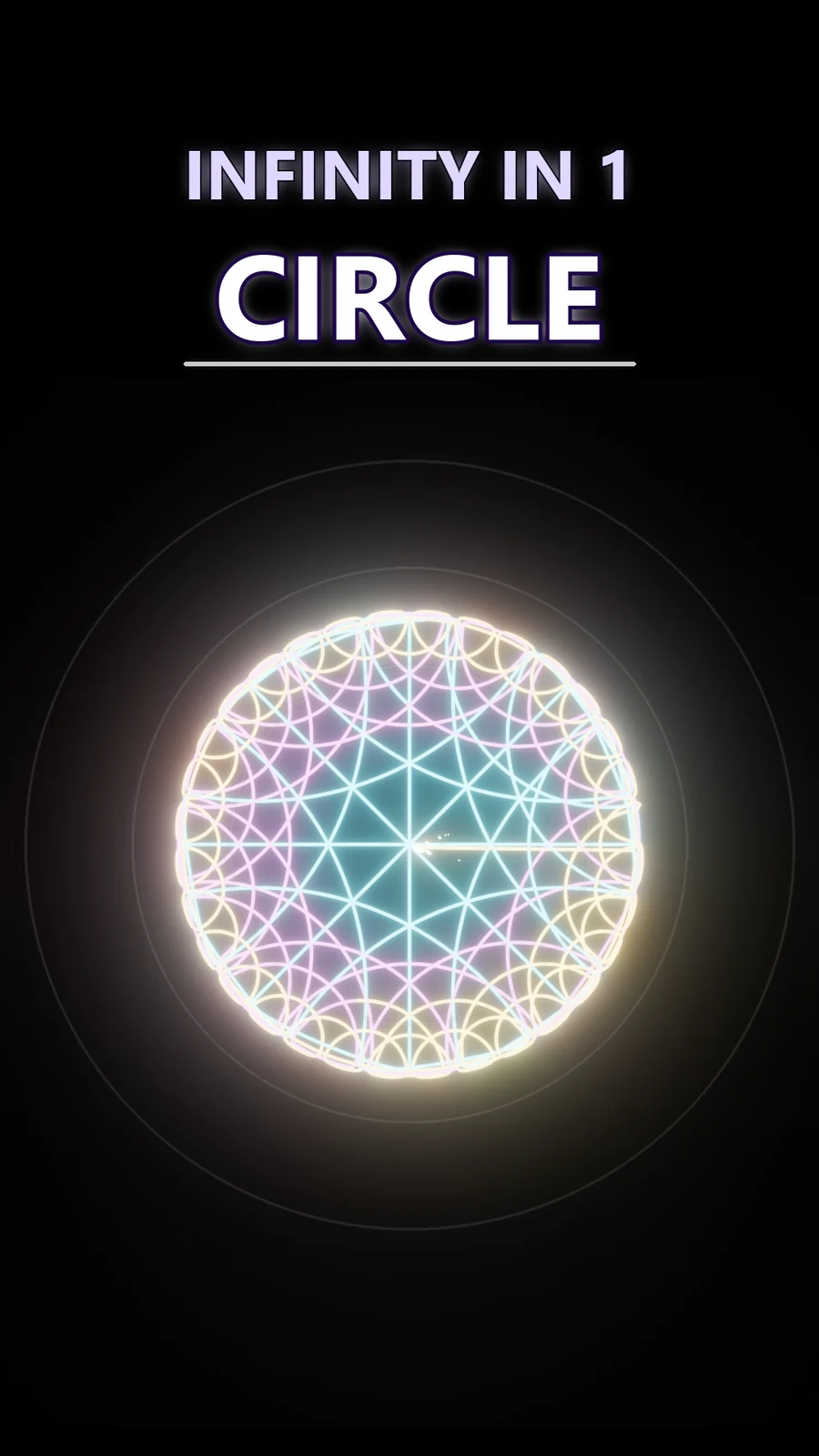
What If Infinity Fits Inside a Circle?
BEHIND THE WORK
What if infinity could fit inside a single circle? In 1882, Henri Poincaré revolutionized mathematics by constructing the Poincaré Hyperbolic Disk—a complete model of non-Euclidean hyperbolic geometry. Here, Euclid's 5th Postulate (Parallel Postulate) fails completely: through any point, infinitely many lines run parallel to a given line without ever touching. All straight lines are circular arcs that meet the boundary at exactly 90 degrees. As you approach the outer rim, space stretches exponentially to infinity.
Artismathic turns equations into visual art—one function at a time.
#MathArt #HyperbolicGeometry #NonEuclidean #PoincareDisk #Geometry #Mathematics #Escher #Blender3D
THE MATHEMATICAL RULE
WATCH IT COME TO LIFE
Watch the drawing
YouTube loads only after you press play.